Understanding App Store Optimization Cost
What is the real app store optimization cost? Our guide breaks down agency pricing, tool expenses, and ROI to help you create a smart ASO budget.
Figuring out your app store optimization cost isn't about finding a single price tag. It's an investment that can run from practically zero (if you're putting in your own sweat equity) all the way up to $10,000+ per month. What you end up spending really boils down to the path you take: bringing in a specialized agency, subscribing to ASO tools, or rolling up your sleeves and managing it in-house.
Decoding Your ASO Investment Options
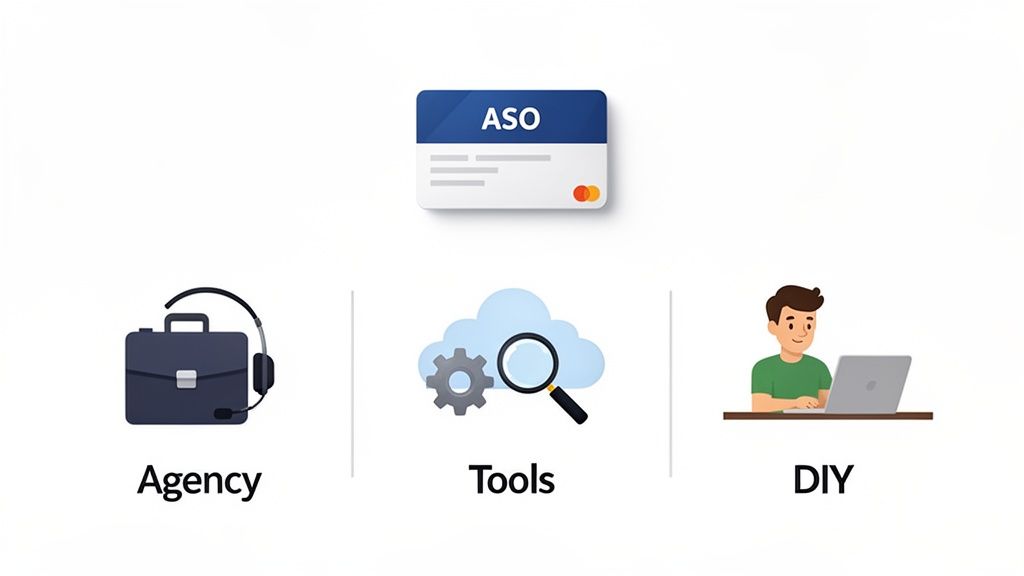
Think of investing in App Store Optimization (ASO) like picking a fitness plan for your app's growth. You could hire a personal trainer (an agency), buy premium gym equipment (ASO tools), or follow workout videos at home (the DIY route). Each approach has its own costs and benefits, and each one will shape how quickly and effectively you can boost your app store growth and conversions.
The right call really depends on your budget, your timeline, and the skills you already have on your team. Getting a handle on these three core approaches is the first real step toward building a growth engine for your app that actually lasts.
ASO Investment Models At a Glance
To make the right call, you need to see how these options stack up side by side. This table gives you a quick, at a glance comparison to weigh the costs, benefits, and drawbacks of each ASO strategy.
| Approach | Typical Monthly Cost | Pros | Cons | Best For |
|---|---|---|---|---|
| ASO Agency | $2,000 – $10,000+ | You get expert strategy, a dedicated team, and comprehensive reporting. | It's the most expensive option and you have less hands on control. | Established apps with a solid budget looking to scale aggressively. |
| ASO Tools | $50 – $500 | Access to data driven insights, competitor analysis, and automation features. | You need someone in house who knows how to interpret the data and act on it. | Teams with some marketing know how who want to make smarter decisions. |
| DIY In-House | $0 – $100+ (for tools) | You have full control, the cash cost is low, and no one knows your product better. | It's incredibly time intensive, has a steep learning curve, and the risk of making costly mistakes is high. | Bootstrapped startups and indie developers with more time than money. |
As you can see, it's all a trade off between money, time, and control. An agency sells you expertise for a premium, tools give you the data if you're willing to learn, and the DIY approach saves cash but costs you time.
App Store Optimization is the single most cost effective user acquisition strategy because it targets users with high intent at the exact moment they are looking for a solution.
And the data backs this up. A whopping 65% of all total installs across the major app stores now come from organic downloads. This is exactly why ASO is such a critical investment for anyone trying to grow sustainably without just throwing money at expensive ad campaigns.
At the end of the day, your ASO spending is just one piece of the puzzle. To really see the big picture, it helps to look at a complete mobile app development cost breakdown to understand where ASO fits into your total budget from idea to launch.
Why ASO Is Your Most Sustainable Investment
Let's be real: paid user acquisition (UA) often feels like running on a hamster wheel. You pump money into ads, you get a spike in downloads, and the second you turn off the spend… crickets. Your visibility evaporates, and your numbers can fall right off a cliff.
It’s an exhausting cycle. You're basically just renting your audience's attention, not earning it. When the ad budget dries up, so does the flow of new users, and you're right back where you started.
The Soaring Cost of Renting Visibility
It’s not just that paid channels are temporary; they're getting ridiculously expensive. The competition for ad space is fierce, driving the cost per install (CPI) through the roof and making a positive return on ad spend harder and harder to achieve. This forces you into a high stakes game of acquiring users who might not even stick around.
The numbers are staggering. Global app marketing spend is projected to hit $109 billion in 2025. A massive $78 billion of that is earmarked for user acquisition, with another $31 billion spent just trying to win back old users. These stats paint a clear picture of a costly, unsustainable path. You can dig into more of these app marketing data trends from AppsFlyer to see for yourself.
This cash burn model just isn't built for most developers, especially those without venture capital level funding. It creates a painful choice: keep spending more just to stay visible, or cut back and risk becoming invisible.
Building an Asset, Not an Expense
This is where App Store Optimization (ASO) completely changes the game. Investing in ASO isn't a short term expense; it's a long term play to build a powerful, organic foundation that attracts users on its own. Think of it as owning your spot in the app store, rather than just renting it for a day.
A smart ASO strategy builds momentum. Every single optimization you make, from tweaking your keywords to redesigning your app store screenshots, adds up. It's a cumulative effect. Your app starts climbing the ranks for relevant searches, which in turn drives a steady stream of high quality, organic traffic.
An investment in ASO builds a resilient, sustainable engine for growth that pays dividends for years. It turns your app store listing into a valuable asset that works for you around the clock.
The Compounding Power of Organic Growth
Unlike paid ads, the benefits of ASO don’t vanish the moment you pause your efforts. A strong organic ranking is an asset that just keeps on giving. Better yet, the users who find your app through search are actively looking for a solution like yours, which means they're far more likely to be engaged and loyal.
This kicks off a powerful, self sustaining cycle:
- Higher Visibility: Good ASO pushes you up in search results, putting your app in front of more potential users.
- More Organic Downloads: That increased visibility naturally leads to more organic installs from high intent users.
- Improved Metrics: A steady stream of engaged users sends all the right signals to the app store algorithms, think better ratings and higher retention.
- Stronger Rankings: These positive signals reinforce your app's authority, boosting its rankings and visibility even further.
This flywheel effect is the real secret to sustainable app growth. While paid ads give you a temporary sugar rush, ASO builds the foundational strength your app needs to thrive for the long haul. It systematically drives down your overall user acquisition costs and creates a reliable growth channel that isn't dependent on a constant cash burn.
Decoding ASO Agency Pricing And Services
When you start looking for an ASO agency, you’re not just buying a service; you're investing in expertise and a clear path to growth. But what do you actually get for your money? The real app store optimization cost can swing wildly depending on the agency, and it usually falls into a few common pricing models. Getting a handle on these is the first step to sifting through proposals and finding a partner that actually gets what you’re trying to do.
Most agencies you'll talk to work on a monthly retainer. Think of it as putting a dedicated team on your payroll, constantly working to improve your app's presence. For this kind of ongoing partnership, you can expect to invest anywhere from $2,000 to over $10,000 per month.
Of course, that’s not the only way. Some consultants or smaller shops might offer hourly rates, which can be perfect for quick, specific jobs. You might also see one off project fees for things like a full ASO audit or a refresh of your screenshots. These are great if you're on a tight budget or just want to dip your toes in the water.
What Services Are Included In An Agency Retainer?
That monthly retainer isn't just a random fee; it's an all access pass to a suite of services designed to bring in steady, organic growth. While the specifics can vary, a solid ASO partnership usually bundles a core set of deliverables that work together to get your app seen and downloaded.
Here’s what you should typically expect to be included:
- In-Depth Keyword Research: This is way more than just guessing what people search for. Agencies use powerful tools to pinpoint high traffic, low competition keywords your ideal users are typing into the search bar right now.
- Competitor Analysis: A good agency keeps a close eye on your rivals. They'll track their keyword strategies, creative updates, and ranking shifts to spot openings for you to pull ahead.
- Metadata Optimization: This is the art of writing your app title, subtitle, and descriptions. It's a delicate balance between ranking for the right keywords and convincing a real human to care enough to learn more.
- Conversion Rate Optimization (CRO): Through constant A/B testing of your icon, screenshots, and preview videos, agencies figure out exactly which visuals get the most people to tap that "Install" button.
- Detailed Performance Reporting: You won't be left in the dark. Expect regular, easy to read reports that show you what’s working, things like organic install growth, keyword ranking improvements, and conversion rate lifts. This is how you prove ROI.
This chart helps put it all in perspective, showing how ASO fits into your overall growth plan compared to the short term rush of paid ads.
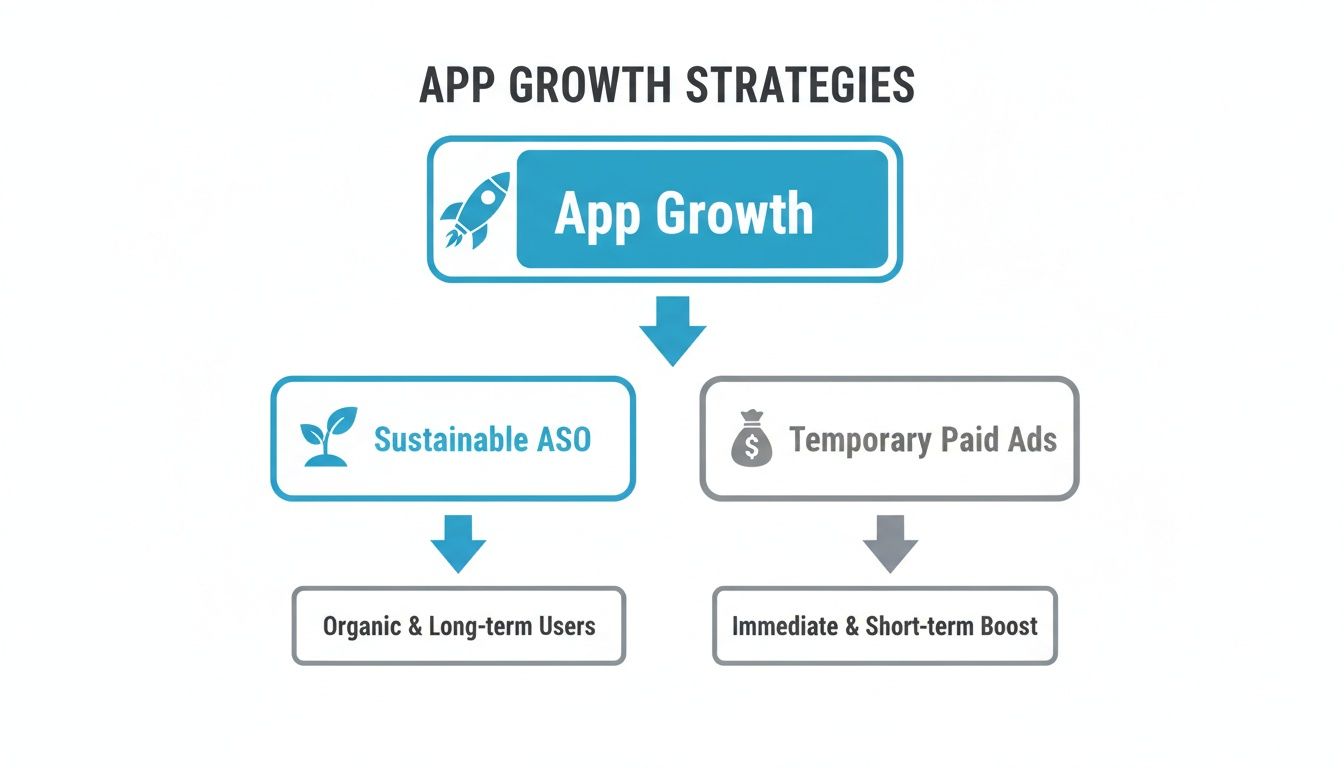
The big takeaway here? Paid ads are like a shot of adrenaline, a quick boost that fades. ASO is like building a strong foundation that supports organic growth for the long haul, delivering value long after you've paid for it.
Choosing A Service Model That Aligns With Your Budget
Not every app needs a full blown, all inclusive package. The right pricing model really comes down to your app's current stage, your budget, and how fast you want to grow. To give you a better idea, let's break down what different investment levels can realistically get you.
A well structured ASO proposal should clearly outline the exact deliverables, the strategic goals, and the KPIs that will be used to measure success. It’s a partnership built on transparency and shared objectives.
The table below lays out some sample ASO budgets and what you can typically expect for your money. Use this as a guide when you’re looking at proposals to figure out what level of investment makes sense for your app right now.
Sample ASO Budgets And Expected Outcomes
This table breaks down what different budget levels can typically achieve in ASO, moving from basic optimization to a comprehensive growth strategy.
| Budget Level | Monthly Cost Range | Typical Activities | Expected Outcome |
|---|---|---|---|
| Starter | $2,000 - $4,000 | Foundational keyword research, metadata optimization, basic competitor tracking, and initial creative recommendations. | Improved keyword rankings for core terms, a modest increase in organic visibility, and a baseline for future growth. |
| Growth | $4,000 - $7,000 | Everything in Starter, plus ongoing A/B testing of creative assets, localization for one or two key markets, and advanced reporting. | Significant gains in organic downloads, improved conversion rates, and expansion into new international markets. |
| Scale | $7,000 - $10,000+ | All of the above, plus aggressive localization, advanced CRO, feature graphic optimization, and deep strategic guidance. | Market leadership in key categories, sustained high velocity organic growth, and a dominant presence in the app stores. |
Ultimately, choosing an agency is about finding a partner who not only gets the technical side of ASO but also understands your business goals. By knowing these pricing models and what they include, you can walk into those conversations with confidence and pick a plan that’s going to light a fire under your app’s growth.
How Creative Assets Drive Conversions and Costs
Your app store visuals are your digital storefront. It's the first thing people see. Long before they read your carefully crafted description or scroll down to check reviews, their eyes land on your app icon and screenshots. These aren't just decorations; they're your most powerful conversion tools, directly impacting both your app store optimization cost and your return.
Think of it like this: your keywords get potential users to the door, but it's your creative assets that convince them to step inside. High quality, compelling visuals can send your install rate through the roof. On the flip side, poor or generic designs will turn users away in a heartbeat. The decision to tap "Install" often happens in less than three seconds, so that first impression is everything.
And this is where the costs really start to stack up. Traditionally, getting these assets made meant a serious investment in both time and money.
The Traditional Route: High Costs and Long Timelines
For a long time, the only real option was to hire a professional designer or an agency. While you can get fantastic results this way, it comes with a hefty price tag and a process that drags on and on.
Here’s a breakdown of the old school approach:
- Briefing and Quoting: You spend hours writing up a detailed design brief, hunting for good designers, and then waiting for them to send back quotes. Just this first step can eat up several days.
- Design and Revisions: The designer sends over some initial mockups. Then comes the inevitable back and forth with feedback and revisions, which can easily stretch the timeline by another week or two.
- Final Delivery: Once you finally approve the designs, the designer has to export and deliver every single required size for both the App Store and Google Play. More waiting.
All told, this entire cycle for just one set of screenshots can run you anywhere from $500 to $3,000, sometimes even more. And what happens when you need to update your visuals for a new feature or a holiday campaign? You guessed it, you start the whole expensive, time consuming process all over again.
A Modern Approach: Efficient and High-Converting Visuals
Thankfully, the old way is no longer the only way. Modern tools have completely changed the game, letting developers and marketers create professional, high converting screenshots in minutes, not weeks. Platforms like ScreenshotWhale offer a much faster and more cost effective alternative.
The key to boosting app store growth is creating visuals that tell a clear story. Your screenshots should instantly communicate your app's core value and show users exactly what problem you solve for them.
Instead of starting from a blank canvas, you can use professionally designed templates and a simple drag and drop editor. This puts the power of great design right in your hands, cutting out the long delays and high costs of the traditional route. You can learn more about how to create high-converting app store images that drive downloads and see these principles in action.
Create Stunning Screenshots in Minutes
Let's walk through a practical example. Imagine you have a new fitness app and need to create efficient and high converting app store screenshots for the Android and iOS stores, fast.
- Select a Professional Template: In the site editor, browse templates designed for fitness apps. A good template provides a solid, ASO friendly foundation to build on.
- Upload Your App Screens: Next, just drag and drop raw screenshots from your app. The tool automatically frames them in slick device mockups, like an iPhone 16 Pro or a Google Pixel.
- Add Compelling Captions: Write short, punchy headlines that focus on user benefits. Use the text editor to input "Track Your Progress" or "Personalized Workout Plans", clear and to the point.
- Customize to Match Your Brand: Use the color picker to change the background to your brand's vibrant orange. Select your brand font from the dropdown menu to keep everything looking consistent and polished.
- Export for All Devices: With a single click, the tool generates every required screenshot size for every device on both the App Store and Google Play. Done.
This screenshot editor shows just how simple and intuitive the process is, combining ready made templates with easy customization.
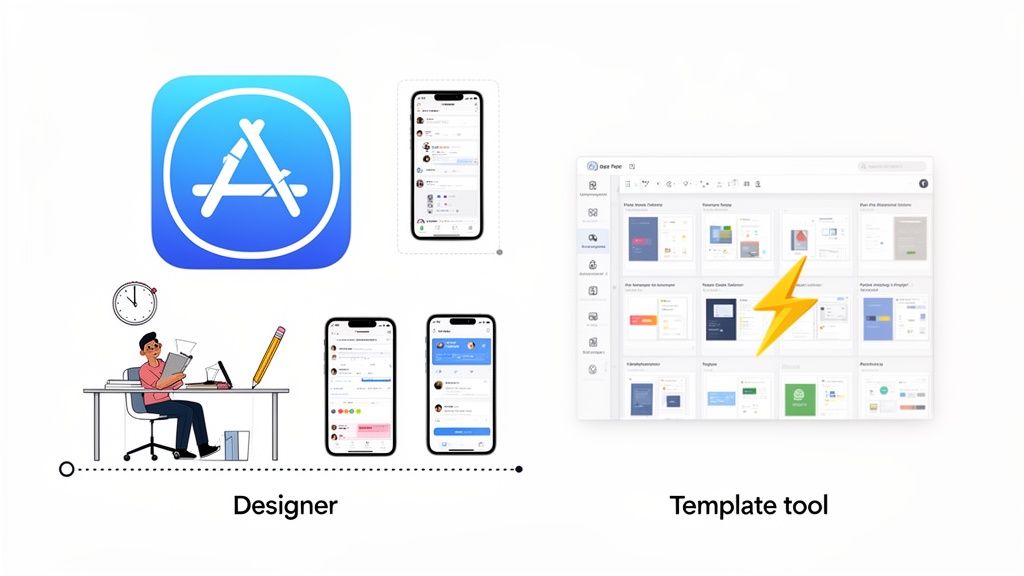
This just goes to show, you don't need to be a designer to create visuals that look great and actually convert.
By using an efficient tool, a project that used to take a week and cost thousands of dollars becomes something you can knock out in under an hour for a tiny fraction of the cost. This speed and affordability is a game changer. It means you can A/B test different visuals, update screenshots for new features instantly, and create seasonal campaigns without blowing your budget. Ultimately, this modern approach lets you produce top tier creative assets that boost conversions and fuel growth, without the traditional financial headache.
The Hidden Cost of App Localization
Thinking about taking your app global? It's one of the best ways to kickstart serious growth, but it definitely adds a new line item to your app store optimization cost. And it's not as simple as just translating your app's description into a few new languages.
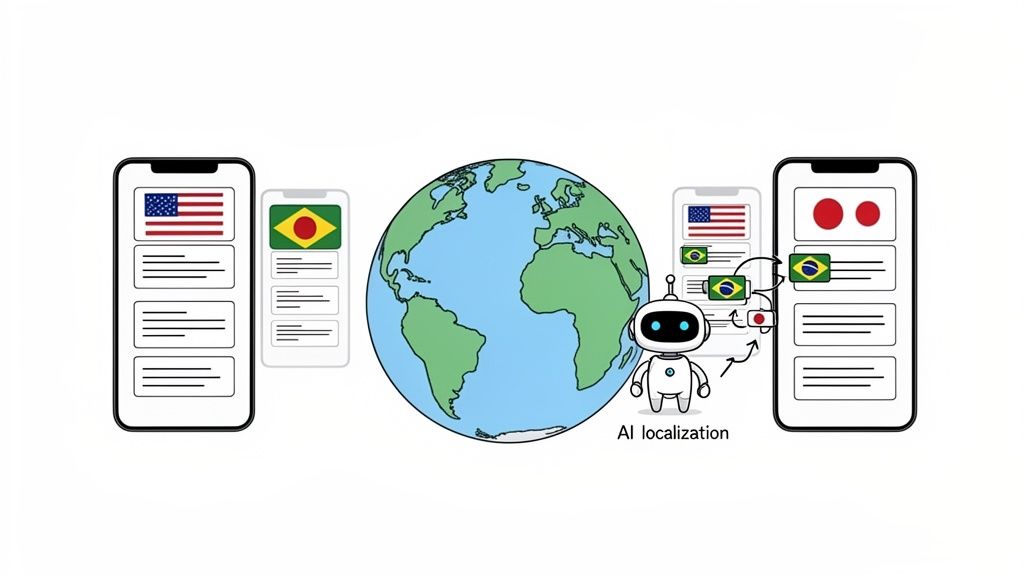
True localization means you have to culturally adapt everything. We're talking screenshots, captions, your core marketing message, the whole nine yards. It’s about understanding the little things in each new region, from cultural inside jokes to what users actually expect to see. A color or phrase that lands perfectly with an American audience might fall completely flat, or worse, be offensive, in Japan or Brazil. Getting this deep adaptation right is how you build trust and actually get people to hit that download button.
The Traditional Costs of Going Global
In the old days, and for many teams still today, localization was a budget killer. It was expensive, slow, and a logistical headache. The manual process involves a chain of time consuming steps that make your costs balloon, especially if you’re trying to launch in more than one or two new countries.
The old school workflow usually goes something like this:
- Hiring Translators: First, you have to track down professional translators for every single language. And not just any translators, you need people who understand the cultural context of your app's niche.
- Endless Designer Coordination: Every piece of translated text for your screenshots then gets kicked over to a designer. That designer has to manually place the new text into the visuals, often wrestling with words that are suddenly way too long or too short for the original layout. It breaks everything.
- Version Control Nightmare: Now, repeat that entire process for every language. You quickly end up drowning in dozens of separate design files, trying to manage feedback loops between translators, designers, and your marketing team.
It’s a fragmented, manual mess. This approach adds a ton of overhead to your ASO budget and makes scaling globally feel like an impossible dream for most developers. With every new market, the costs just multiply.
How Automation Slashes Localization Costs
Thankfully, technology is tearing down these old financial walls. Modern automation tools have made effective localization a totally achievable and affordable goal, turning what was once a massive expense into something you can actually manage. They handle the most mind numbing parts of the job, saving you a huge amount of time and money.
Technology can drastically cut your internationalization budget and make scaling worldwide a realistic goal for apps of any size. Automation handles the repetitive work, freeing you to focus on growth strategy.
Platforms like ScreenshotWhale build AI powered localization right into the creative workflow. Picture this: you design one perfect, high converting set of screenshots. Then, with a single click, the tool’s AI translates all your captions and headlines into dozens of different languages. It even adjusts the font sizes and layouts automatically to make sure everything looks perfect in every single language.
It’s a complete game changer. That whole agonizing cycle of hiring translators, briefing designers, and managing endless revisions gets crunched down into a few seconds. If you want to dive deeper into these modern tactics, check out our complete guide on mobile app localization.
The ROI of Efficient Localization
Here's the best part: investing in smart, efficient localization pays for itself almost instantly. When you meet users in their native language, your app’s appeal and conversion rates shoot up. It’s the key to unlocking new revenue from around the world without having to proportionally jack up your marketing budget.
The results of a well oiled localization strategy, fueled by ASO, can be massive. For example, brands that get serious about ASO have seen their organic installs jump by 150% year over year. One educational app managed to launch in 30 new markets just through localization, pulling in tens of thousands of organic users without spending a dime on paid ads. These numbers, highlighted in ASO findings from AppInstitute, show just how cost effective this can be.
By letting smart tools do the heavy lifting, you can enter new markets faster, test your localization strategy with almost zero risk, and scale your global footprint in a way that just wasn't possible before. It flips the script, turning localization from a huge cost center into a powerful engine for profitable growth.
How To Measure Your ASO Return On Investment
Let's be honest, talking about app store optimization cost is only looking at one side of the coin. The real win isn't finding the cheapest service; it's getting the best possible return on what you spend. When you start measuring your return on investment (ROI), you stop thinking of ASO as an expense and start seeing it for what it is: a powerful investment in your app's future.
Getting a clear picture of your ROI proves your efforts are paying off. It helps you justify the budget and, more importantly, tells you exactly where to double down for maximum impact. Think of it as a simple equation: what you spend versus the value you get back.
Key Performance Indicators That Actually Matter
Before you can even think about calculating ROI, you need to track the right metrics. These Key Performance Indicators (KPIs) are the vital signs of your ASO health, giving you the hard data needed to measure success.
Don't get lost in vanity metrics. Focus on these three core KPIs:
- Organic Install Growth: This is the big one. A steady increase in organic downloads from the App Store and Google Play is the clearest signal that your ASO strategy is hitting the mark.
- Keyword Ranking Improvements: Keep a close eye on where your app ranks for its most valuable keywords. Climbing up those search results directly translates into more eyeballs and more potential users.
- Conversion Rate Uplift: This is the percentage of people who actually install your app after landing on your store page. A rising conversion rate means your screenshots, icon, and description are doing their job and convincing people to hit "Download."
To really connect the dots, it helps to understand the fundamentals of how to calculate marketing ROI in general. This knowledge bridges the gap between your ASO spending and the tangible results you're seeing in your analytics.
Calculating Your ASO ROI
Once you're tracking your KPIs, the ROI calculation itself is surprisingly straightforward. You're just comparing your total ASO expenses to the value of the organic users you brought in.
The goal isn't finding the cheapest ASO solution, but the one that delivers the greatest return and fuels sustainable, long term app growth.
First, tally up all your ASO related costs for a given period, say, a month. This includes any agency fees, subscriptions to tools like ScreenshotWhale, or even the cost of your team's time spent on ASO tasks.
Next, figure out what an organic user is worth to you. A simple way to do this is to benchmark against your cost per install (CPI) from paid ad campaigns. If you're paying $2.00 for every install from an ad, then every organic install you get is effectively $2.00 saved.
So, if you spent $3,000 on ASO last month and it brought in 2,000 new organic users, you've essentially generated $4,000 in value (2,000 users x $2.00 CPI). Your ROI is positive, you're getting more back than you're putting in.
This process also highlights why continuous testing is so critical. To see how to systematically improve these numbers, it’s worth exploring how a well run ASO A/B test can make all the difference.
A Few Common Questions About ASO Costs
When you're trying to figure out your ASO budget, a few key questions always seem to pop up. Let's tackle them head on with some straight answers, based on what we see every day in the app world.
How Much Should a Small App Spend on ASO Per Month?
For an indie developer or a small app that’s just getting its feet wet, a good starting point for an ASO budget is somewhere in the $500 to $2,000 per month range. This isn't just a random number; it's a practical amount that lets you cover the essentials without breaking the bank.
With that kind of budget, you can get access to solid tools for tracking keywords and keeping an eye on your competitors. It also gives you enough breathing room to get professional looking screenshots made. The whole idea at this stage is to nail the fundamentals, great metadata and compelling visuals, because that’s where you’ll see the biggest bang for your buck early on.
Is Hiring an ASO Agency Worth the Cost?
Bringing on an agency can be a game changer, especially if you're short on time or don't have an ASO expert on your team. Yes, the app store optimization cost is a bigger line item, often starting at $2,000+ per month, but you're paying for expertise and momentum.
What you get for that money is a team that lives and breathes this stuff. They provide ongoing optimization, dive deep into the data, and give you clear reports on what’s working. It's a worthy investment if your goal is to grow fast and you want to use pro level knowledge to carve out a real advantage in the app stores.
Can I Do ASO for Free?
Sure, you can definitely get started with ASO for free by rolling up your sleeves and putting in the time. This DIY route means you’re manually digging for keywords using the app store's search suggestions, writing all your own metadata, and designing your own screenshots.
But let's be real: to get professional level growth, you almost always need to invest some money. Specialized tools are what give you accurate data, show you what your competitors are up to, and let you run A/B tests. These things are absolutely critical for making smart, data backed decisions that actually move the needle.
Even a small investment in the right tools can seriously multiply your efforts, delivering a far better return than just grinding it out manually.
Ready to create stunning, high-converting screenshots without the high designer fees? With ScreenshotWhale, you can design professional App Store and Google Play visuals in minutes using our powerful editor and ASO-optimized templates. Start boosting your conversions today at https://screenshotwhale.com.
Put this into practice on your own listing
Import your live app into an ASO workspace — metadata, keywords, competitors, and store screenshots in one place.
Import my app